Akinobu Kurokawa
here, there and everywhere
点々と、延々~
Press release
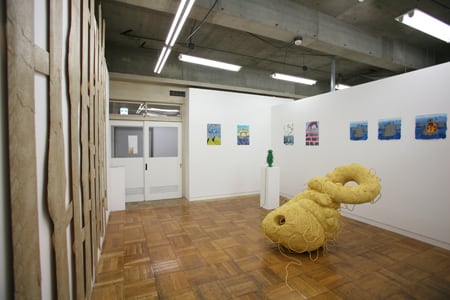
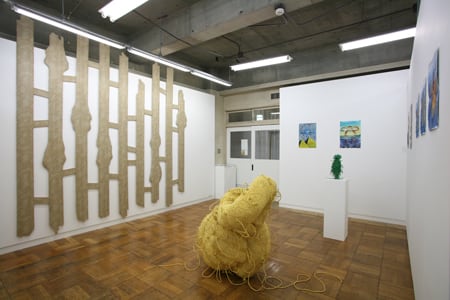
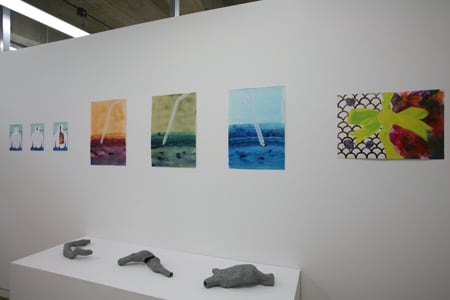
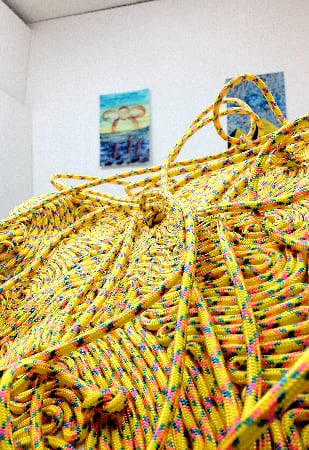
'I feel as if I am living inside an endlessly continuing amidakuji,' says Kurokawa. The work that first catches the eye in the exhibition space, 「占っている」, represents an amidakuji, and for it Kurokawa uses the image of a snake shedding its skin as a symbol of what continues 'endlessly'. Kurokawa seems to make his works by trying to grasp tactilely the 'material' as an image for knowing the world. Not visually but tactilely, like a snake crawling, twisting and meandering, he expresses the movement of continuing to try to perceive the boundary between the world and what is other than it by giving three-dimensional form to the structure of the amidakuji. That movement also leads into the work 「判断のしどころ」. A three-dimensional work made from a single cord, it takes a form like a mix of a heart (the boundary of life and death) and a Klein bottle (the boundary of space), and it also looks like a gathering of Japanese striped snakes. It carries an image in which the boundary of body and world becomes intertwined. Kurokawa seems to be trying here to define a certain kind of boundary. But the moment one tries to define such a boundary, the image melts away, leaving only a single cord. 「判断のしどころ」 holds together with a precarious tension, seemingly graspable yet ungraspable. Kurokawa's drawings are also drawn with this kind of tension. As seen in 「お前だけの」 and 「無題」, though tossed about by the symbolic and highly chance event of being struck by lightning (or something like lightning), perhaps that is the only way we and the world can find a point of contact (in the bleeding effects he uses frequently, too, one can see his interest in this chance quality and in tactile expression). As for the heart, the motif of the aforementioned 「判断のしどころ」, although it plays the important role of determining life, it is not an organ that moves by human will. Kurokawa translates the title of this exhibition, 「点々と、延々~」, as "here,there and everywhere", and it comes to seem that in daily life we accept the chance that can become symbolic. Kurokawa does not try to grasp the moment of making contact with the world as something fraught with tragedy; rather, he seems to enjoy it: 'What would happen if I swallowed something, if the cord started to look like this, if I were struck by lightning?' When asked about the support around which the cord is wound, Kurokawa answered, 'There's no content, it seems.' 'Rather, I'd like something like that to be inside,' he also said. A viewpoint that surveys that self-deprecating behavior from above, at the same time with humor mixed in, seems to be his particular quality. It is difficult to grasp the world and its form, and to recognize the boundary between the world and what is other than it. The moment we feel we have grasped the world, there is always the possibility that the world will again suddenly vanish, leaving only a single cord. But even so, the cord alone must surely remember: the form of the world, and its boundary. Yes, the cord can also be taken as a representation of the snake. Kurokawa had already begun, in his twenties, to present a three-dimensional tactility that cuts out a part of the world, and at last it seems to be taking shape. There have been artists who have thought about the distance from the world and the problem of boundaries, but Kurokawa is probably one of the few artists who, making full use of various materials and carrying irony and humor, is trying to grasp it.
プレスリリース
「延々と続くあみだくじの中を生きているように感じる」と黒川は語る。展覧会場で最初に目に入ってくる作品「占っている」は、あみだくじを表象したものであるのだが、これに黒川は「延々」と続くものの象徴として脱皮する蛇のイメージを使う。 黒川は、世界を知るためのイメージとしての「素材」を触覚的に把握しようと試み作品をつくっているように思える。視覚的ではなく、触覚的に、蛇のように這い、ねじれ、蛇行しながら世界とそれ以外のものの境界を知覚しようとし続ける動きを、彼はあみだくじ構造を立体化することによって表現している。 その動きは、「判断のしどころ」という作品にもつながっていく。一本の紐からつくられた立体作品 で、心臓(生死の境界)とクラインの壺(空間の境界)をミックスしたようなかたちとして表され、それはまたシマヘビが集合しているかのようにも見える。それは身体と世界の境界が綯い交ぜになるようなイメージをともなうのだ。黒川は、ある種の境界をここで策定しようと試みているようだ。しかし、そうした境界を策定しようとした瞬間、そのイメージは一本の紐だけを残して溶けてしまう。掴めそうで掴めない、危うい緊張感で「判断のしどころ」は成立している。 そうしたある種の緊張感をともないつつ、黒川のドローイングも描かれている。「お前だけの」「無題」に見られるように、稲妻(のような何か)に打たれるという、象徴的であり偶然性の強い出来事に翻弄されながらも、我々と世界はそうでしか接点を見出せないのかもしれない(多用している滲みの表現にも、その偶然性と、触覚による表現への関心が伺える)。 先の「判断のしどころ」のモチーフである心臓についても、生命を左右する重要な役割を担っているのにも関わらず、人の意志で動く臓器ではない。今回の展覧タイトル、「点々と、延々~」を黒川は"here,there and everywhere"と訳しているが、日常的に我々はその象徴的になり得る偶然を我々は受け入れているように思えてくる。 黒川は、世界との接点を持つ瞬間を悲劇性を孕んだように捉えようとはしておらず、むしろ、「なにかを 飲み込んだら、紐がこう見えてきたら、稲妻に打たれたらどうなるのだろう」と、楽しんでいるように思える。紐を巻く支持体について訪ねられた際に、黒川は「内容はないよう」と答えていた。「むしろ、そういうものが入っていて欲しい」とも。その自虐の振る舞いを、同時にユーモアを交えて俯瞰する視点が彼の特質であるように思える。 世界、そのカタチをとらえ、世界とそれ以外のものの境界を認識することは難しい。世界を掴んだと感じるや否や、世界はまたふっと一本の紐だけを残し消え去る可能性は常にあるのだ。しかし、それでも紐だけは記憶しているにちがいない、世界のカタチを、そしてその境界を。そう紐はまた蛇の表象ともとれるのだ。 世界の一部を切り取る立体的な触覚性の提示を黒川は既に20代にして始めていたが、ようやくそれがかたちづくられつつあるようだ。世界との距離、境界の問題を考えてきた作家はいるが、黒川は色々な素材を駆使し、皮肉とユーモアを携えながら、それを捉えようとしている数少ない作家であろう。
Installation views 展示風景