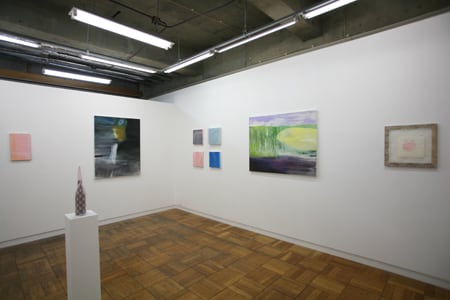
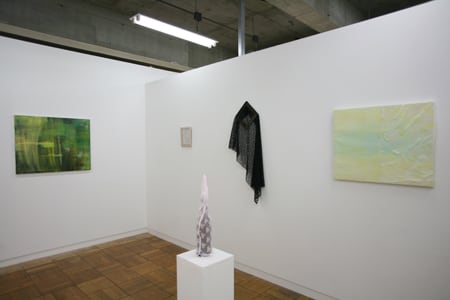
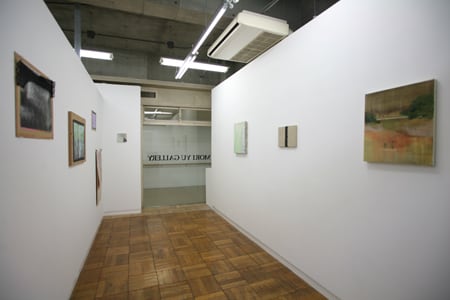
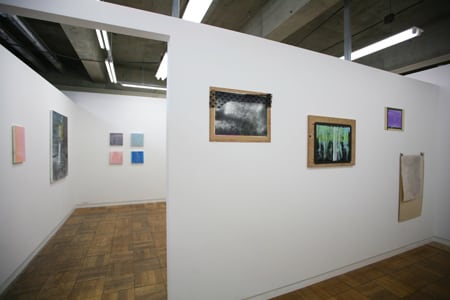
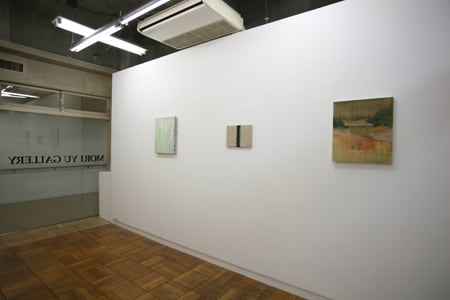
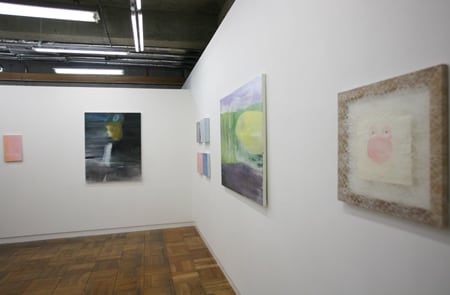
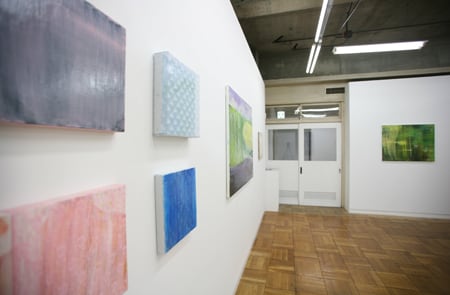
Sera,Tsuyoshi "Que sera sera"
セラツヨシ「ケセラセラ」
Press release
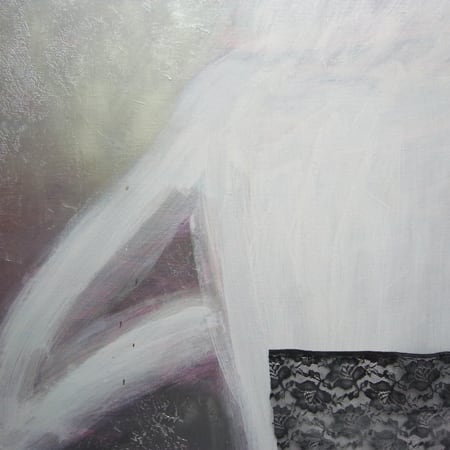
You are quiet like a cat, sometimes lively, and against the fate that falls upon you I can do nothing at all for you. I can only face the white canvas and the lace of thin, frail mesh that spreads like the universe, and accept everything. Tsuyoshi Sera The drawing of a woman with the face of a frog, affixed inside a wooden frame, is gently enveloped, as if sealed, in delicate lace fabric. In the paintings born through his own experiences and memories, lace covers abstracted motifs, is embedded in them, and at times is torn away. The works of Tsuyoshi Sera, which have so far dealt with the repetition of life and death that has continued since ancient times as their theme, and above all with living, that is, the form in which life exists now, are currently made with the use of lace as their characteristic. The history of lace is said to have begun in ancient Egypt and passed to Europe; at first, used for instance in the decoration of armor, it was in greater demand among men than among women and belonged to the privileged classes, but with the development of manufacturing techniques it spread to the general public and came to be used abundantly in fashion. Now it has become an indispensable part of women's underwear and has melted into everyday life so much that one is not even aware of its existence. This transition is also like the one that art has followed until now; moreover, in addition to romantic and feminine, neat or sexy images, inspiration is provoked by its delicate appearance and its distinctive effects of light; the branching of the fine mesh, thin, frail and wavering, somehow calls to mind a human life, and the regularly arranged geometric patterns also look like a mandala, leading into the infinitely expanding universe. 【Artist profile】 Born in 1974. Spent his boyhood in a remote part of the Shimane countryside, familiar with traditional Buddhist customs and practices, Iwami Kagura and myths. He began drawing from an early age, and was influenced by Japanese manga and, through art education in the countryside, by the typical Impressionism, Post-Impressionism, Abstract Expressionism and Neo-Expressionism. His activity began in earnest during his university years: while studying at Osaka University of Foreign Studies, he researched where human image-formation comes from, taking imaginary beings (mainly yokai and the like) as his subject and comparing Japan and abroad; then, in 2000, he studied fine art at the National Art School in Australia, and has continued to make work in the field of contemporary art while moving his base between Osaka, Sydney and Tokyo. The Buddhist idea of reincarnation that has influenced him since childhood runs through the core of his works, and a cosmic sense of endless repetition also appears in his brushwork and colors. As mentioned above, he works with 'life and death' as his theme by gazing at present 'life', and has reconsidered and constructed image, space, color, time, people, things, relationships and so on. The frog that appears in his works, prompted by the death of someone close to him, is 'the frog glared at by a snake', unable to move a muscle; he likens this state to human life = destiny, expressing a reality in which one has no choice but to accept both good and bad, and, taking as subject 'Yamata no Orochi', the eight-headed serpent of one of Shimane's myths, he symbolizes 'the figure of surviving the present'. At times, drawing on various experiences, he takes as motifs fragments of cheap everyday things and trivial events around him, awakening people to their own possibilities, finding the beauty hidden in banal phenomena, and creating contexts in which new relationships are formed and meaning is gained. This is close to the current of Micropop, a concept proposed by the art critic Midori Matsui, one tendency of artistic expression that appeared in Japan from the mid-1990s to the early 2000s. However, rather than depicting the everyday as everyday, he depicts an ambiguous world that is both figurative and abstract, and by further covering it with lace, the 'ambiguous world' fixed there becomes even more ambiguous. The shadows produced by the lace change depending on the place of viewing; at the same time as sensing the possibilities of a life wrapped in a veil, viewers, as if touched by fragments of past memories and thoughts, feel welling up in them the thought 'I have seen this somewhere', 'I have done this', and can enter into the work; it permeates further the images each person creates, and draws out the empathy of people living in contemporary society. (Tsuyoshi Sera)
プレスリリース
君は猫のようにおとなしく、時に活発で 降り掛かる運命に、僕は到底何もしてあげることが出来ない ただ、白い画布と宇宙のように広がる細く弱々しい網目のレースと 向き合って、すべてを受け入れることしか出来ないでいるんだ ーセラツヨシー 木枠の中に貼付けられた蛙の顔をした女性のドローイングは、可憐なレース生地に封印されるがごとくやさしく包み込まれている。自身の経験、記憶を通じて生み出されるペインティングは抽象化されたモチーフにレースが覆い被さり、中に埋め込まれ、時には引き剥がされる。 太古から続く生と死の繰り返しをテーマとして、とりわけ生きること、つまり生命の今存在している姿をこれまで取り扱ってきたセラツヨシの作品は、 現在レースの使用を特徴として制作されている。 レースの歴史は古代エジプトに始まりヨーロッパへ伝わったとされ、当初甲冑の装飾に使用されるなど女性よりも男性のほうに需要があり、 特権階級のものであったが、製造技術の発達と共に一般に広まりファッションに豊富に用いられるようになった。今では女性の下着に欠かせない一部となって、 その存在さえも意識させないほど日常に溶け込んでいる。この推移はこれまで辿った美術のそれの様でもあり、また、ロマンティックでフェミニンな、 清楚あるいはセクシーなイメージに加えて、繊細な外観や独特の光の効果によりインスピレーションが誘発され、細く弱々しくゆらぐ細かい網目の分岐はどこか人の一生を彷彿とさせ、規則的に並んだ幾何学的な模様は曼荼羅のようにも見え、無限に広がる宇宙へと導くのである。 【作家プロフィール】 1974年生まれ。島根の片田舎で伝統的な仏教的風俗習慣、石見神楽や神話に親しみながら少年時代を過ごす。 幼い頃より絵を描き始め、日本の漫画や田舎の美術教育では典型的な印象派、後期印象派、抽象表現主義、新表現主義に影響を受けている。 大学時代に活動を本格化、大阪外国語大学在学中、ヒトのイメージ形成がどのようなところから来るのかを架空存在(主に妖怪など)を題材に 日本と海外との比較から研究、その後、2000年にオーストラリアナショナルアートスクールでファインアートを学び、大阪・シドニー・東京と活動の拠点を移しながら、現代アートの分野で制作を続けている。 幼少期から影響を受けていた仏教的な輪廻思想が作品の根幹を貫いており、延々と繰り返す宇宙的感覚は筆遣いや色にも表れている。前述の通り「生と死」をテーマに、現在の「生」を見詰めることで制作しており、イメージ、空間、色彩、時間、人、物、関わりなどを再考し構築してきた。 自身の近しい人の死を契機に作品内に登場するカエルは、身動ぎ一つできないでいる「蛇ににらまれた蛙」、その有様を人の人生=天命と見立て、 善きも悪しきも受け入れざるを得ない現実を表しており、八つの頭をもつ蛇で島根の神話の一つ「八岐大蛇」を題材にし、「現在を生き抜く姿」を シンボル化している。 時に様々な経験から身の回りの日常の安い物事や取るに足らない出来事の断片をモチーフに取り扱い、人に自らの可能性を目覚めさせ、凡庸な事象に潜む美を見出し、新たな関係性を結び意味を得る文脈を作り出していく。 これは1990年代なかばから2000年代前半にかけて日本に現れた美術表現の1つの傾向で美術評論家の松井みどり氏の提唱した概念であるマイクロポップの流れに近い。しかし日常を日常のまま描くのではなく、具象でもあり抽象でもあるような曖昧な世界を描き、さらに上をレースで覆うことでそこに定着した「曖昧な世界」は一層曖昧になる。 レースによって生み出される影は鑑賞する場によって変化をもたらし、ベールに包まれた人生の可能性を感じると同時に鑑賞者は過去の記憶や思想の断片に触れられた様に『何処かで見たことが ある』『したことがある』という思いが湧いて作品に入り込んでいくことができ、より個々の作り出すイメージに浸透し、現代社会に生きる人々の共感を誘い出すのである。 (セラツヨシ)
Installation views 展示風景